
The Mérida Atmospheric Research Station (MARS)
MIRA 2 was part of the joint Venezuelan, Swedish, and German project of the Mérida Atmospheric Research Station (MARS).
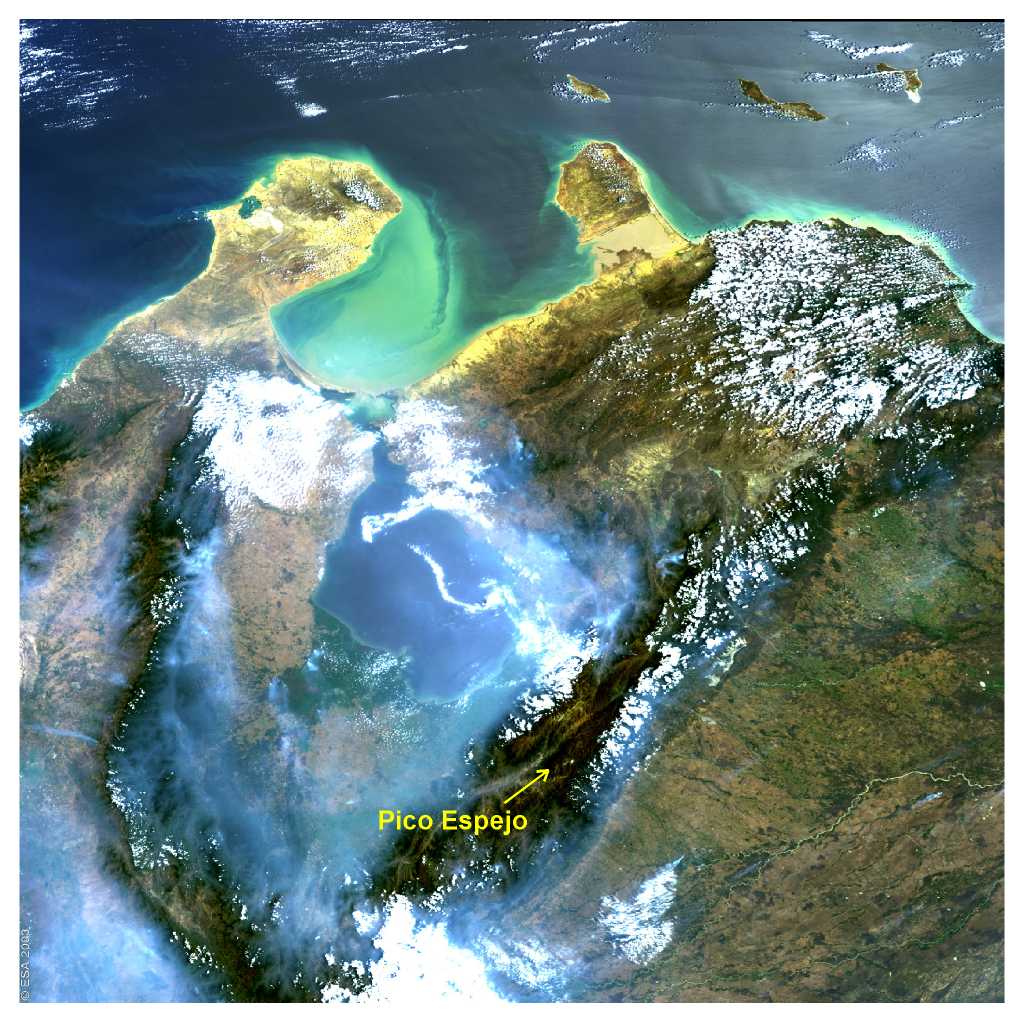
MARS is located on Pico Espejo (8.5314°N, 71.0537°W, 4765 m asl) at Mérida, Venezuela. The satellite picture besides shows the northern part of South America and has been taken by the MERIS instrument on board ENVISAT (© ESA 2003). Clearly visible are the Gulf of Venezuela and Lake Maracaibo. The arrow marks the position of Pico Espejo.
Also installed at this inner-tropical site were the ground-based water vapour radiometer WARAM and a DOAS instrument. These instruments were operated by the Institute of Environmental Physics of the University of Bremen. Measurements of the number density, size distribution, light absorption, scattering, chemical composition and mixing state of aerosols were investigated using a Volatility Tandem Differential Mobility Analyzer by the Department of Applied Environmental Science of the Stockholm University.
Due to its high altitude Pico Espejo provides low tropospheric water vapour column amounts and a high tropospheric transmission. Therefore excellent conditions for ground-based measurements are provided at this inner tropical site. Analyses using NCEP/NCAR data covering the last 50 years suggest that nearly year-round measurements at 270 GHz are feasible. The first results of MIRA 2 confirmed the good tropospheric conditions of this site.
Another advantage of this site was the good accessibility of this high altitude location by the world's highest cable car.
Have a look at the scientific, technical, and organizational summary for this atmospheric research station.