
Project Summary
Fog and low clouds are prominent characteristics of the hyper-arid Namib Desert. However, the mechanisms that act together to determine their occurrence and development, as well as the role of seasonally occurring aerosols from biomass burning, have yet to be quantified. For the same reason, no quantitative estimates of the future development of the Namib-region fog/low cloud system exist. In the proposed project, the role of biomass burning aerosols on fog and low-cloud occurrence and its life cycle will be analyzed on the basis of data from passive and active satellite sensors, reanalyses and local ground-based remote sensing and in-situ measurements. Backtrajectories initiated within local aerosol plumes will be used to analyze fog and low cloud patterns within groups of similar dynamic and thermodynamic conditions. The influence of the major determinants of the Namib-region fog/low cloud system will then be quantified using statistical models. On the basis of the relationships identified and captured in these models, future changes in the fog/low-cloud system will be estimated using climate model output to drive the statistical model.
Project News
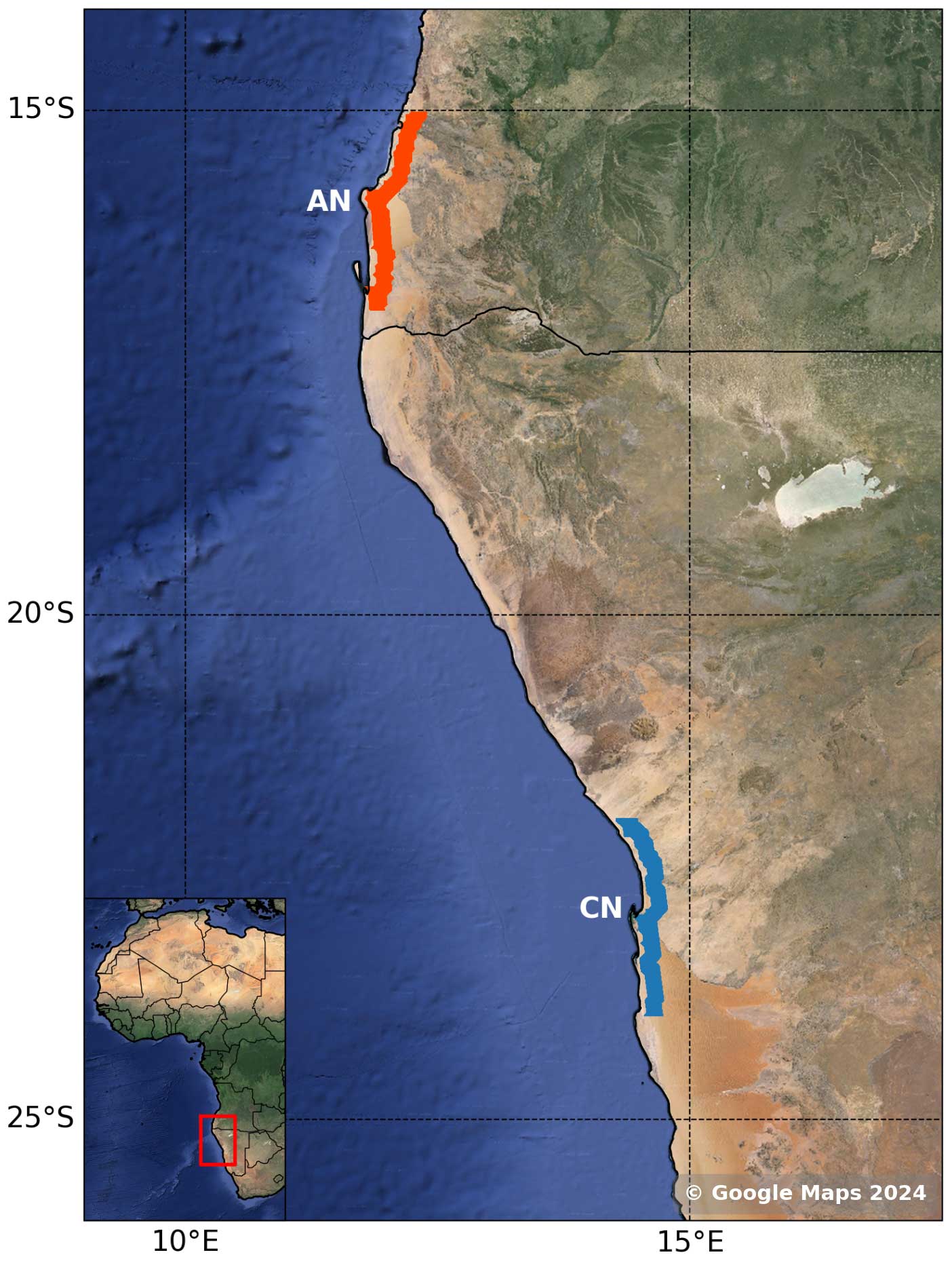
- In our recent publication (ACP, 2026), we investigate the oceanic and atmospheric factors controlling fog and low clouds (FLCs) and their variability in the Namib Desert. Combining satellite observations and reanalysis data within a cloud-controlling factor framework, we quantify the roles of atmospheric stability, humidity, winds and sea surface temperatures, and reconstruct FLC cover anomalies for 1982–2019. The reconstructions show no significant long-term trends, with increased atmospheric stability favoring FLCs and ocean warming counteracting this effect. Our analysis of year-to-year variability highlights the importance of regional ocean conditions: ocean temperature variability explains nearly half of the reconstructed variability in the Angolan Namib and about one-fifth in the Central Namib.
-

Reconstructed fog and low-cloud variability and regional ocean temperature anomalies during 1982–2019 for the Angolan Namib (top) and Central Namib (bottom). Warmer ocean conditions are associated with reduced fog and low-cloud cover. Series are detrended and shown as three-month running means.
- In our recent publication (ACP, 2025), we investigate the interaction between smoke aerosols and fog and low clouds (FLCs) in the Namib Desert between June and October. We make use of a satellite-based dataset of FLCs, reanalysis data and machine learning to systematically analyze FLC persistence under different aerosol loadings. Aerosol plumes are shown to modify local thermodynamics, which increase FLC persistence. But fully disentangling aerosol effects from meteorological ones remains a challenge.
- In our current work, we investigate possible past and future changes of Namibian fog and low clouds in a cloud controlling factor framework, using reanalysis and climate model output. We hope to quantify the resilience of the fog system to climatic changes.